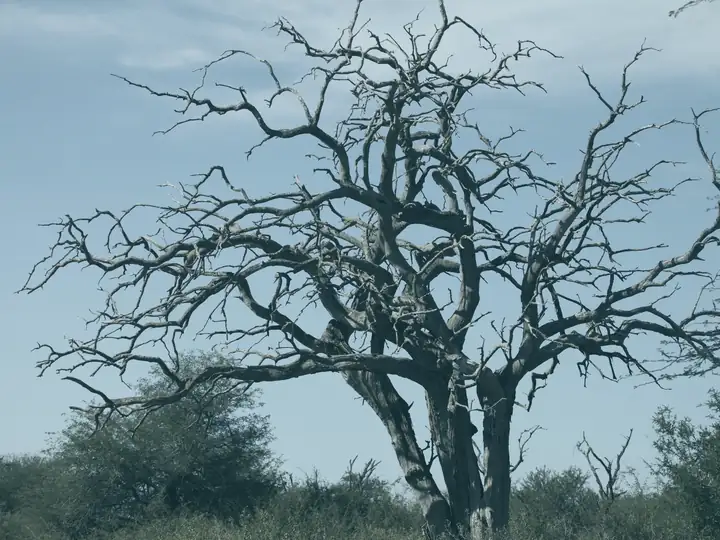
The Kendall County picture
The Kendall County Forest Preserve District says EAB was first detected in the county in 2009. Its director described about every third preserve tree as ash, and said infested trees die two to three years after infestation, often before the damage is obvious (Chronicle Media).
Treat or remove?
Illinois guidance generally says only healthy ash with most of their canopy are worth treating; an ash that has lost more than half its canopy is unlikely to recover (U of I Extension; Morton Arboretum). Trunk injections must be applied by a licensed applicator (Illinois Dept. of Agriculture).
Check your tree
- Crown thinning from the top down.
- D-shaped exit holes, about the size of a pencil eraser.
- Light patches where woodpeckers flaked off bark.
- Shoots sprouting from the trunk base.
- Vertical bark splits with winding tunnels underneath.
Why dead ash is risky
Dead ash dries and turns brittle, and the Forest Preserve District pointed out that weakened roots can leave a tree leaning (Chronicle Media). Branches can snap under a climber. Many crews use a lift or crane on long-dead ash. Tell them how long it's looked dead.
Can the Village make me remove it?
Illinois law lets a municipality treat or remove EAB-infested ash on private property if the owner, after reasonable notice, refuses or neglects to, and recover the cost as a lien on the property (65 ILCS 5/11-20-12).
Dead ash gets brittle fast, so crews often use a lift instead of climbing.
Pencil-tip holes
Exit holes are D-shaped and small, about 1/8 inch across.
Top-down thinning
Canopy dieback starts in the upper crown and works down.
Woodpecker flecks
Light patches of stripped bark where birds hunt the larvae.
Why so many dead ash around Oswego
Emerald ash borer was first found in Kendall County in 2009 (Chronicle Media). The larvae tunnel under the bark and cut off the tree's water and nutrients, so an infested ash usually declines from the top down over a few years. By now, most untreated ash in Oswego subdivisions are dead or close to it. Dead ash dries out and gets brittle, and limbs can drop on calm days, not just in storms.
Parkway ash vs. yard ash
An ash on the parkway, between the sidewalk and curb, is the Village's to deal with; call Public Works at 630-554-3242 (Village). An ash in your yard is yours. If it's near the house, the garage, a fence line or where kids play, put it at the top of the list.
When treatment can work
Treatment protects healthy ash and has to be repeated. Illinois guidance says trees that have lost more than half their canopy are unlikely to recover, and injections need a licensed applicator (U of I Extension; IDOA). For a tree that's already gone, removal is the safer plan before it gets brittle.
Questions to ask
- How much of the canopy is gone?
- Can it be climbed safely, or does it need a lift?
- Who is the licensed applicator if we treat?
- How will the ash wood be handled? Moving firewood spreads EAB.